The pain felt in the
moment of the fracture is similar the pain provoked by the deep decay in human
beings. The painful incentive reaches the dental pulp, present inside the tooth,
popularly nerv" call. The pulp is the alive fabric, responsible for the
nutrition, ripening and sensibility of the tooth. It is constituted of blood
vessels, lymphatic, nervous bunches and slack conjunctive fabric, that it
composes the Endodontic System.
All the
teeth are of they be fractured, however, the inferior and superior canine teeth,
following by the room-pré-molars and incisors are what more presents such lesion
type. In felines, the teeth more reached are the canine teeth.
The
dogs and cats usually fracture their teeth when they gnaw very hard toys and
bones, playing with freesbies and even in fights. Other causes are the
accidents, running over or falls of great heights. In the cases where the tooth
is fractured, it happens an exhibition of this pulp to microorganisms and
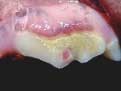
remains of foods that will occupy that pulpal channel (illustration 1). When
that happens, the animal feels discomfort and difficulty of apprehending objects
and foods. When using the teeth for the mastication, he also feels pain.
With
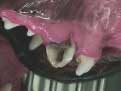
the death of the pulp (illustration 2), the pain tends to cease and the animal
usually returns the feed, not feeling more uncomfortable, however, he is"
apparently" healthy. This is the proprietor's main reason he/she not to notice
that his/her animal is with a fractured tooth.
Did we owe or not to treat
the fractured tooth?
The
channel (I space where is present the pulp) it is filled out by dead fabric and
debris. For the bacteria, this space is everything that they want and don't
please with that, they tend going to the extremity of the root, invading the
bone around the tooth, developing a lesion periapical (osteolysis). This lesion
progresses for an abscess, could form a fistula inside or out of the mouth. The
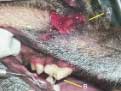
more known by the veterinarians is the Butcher's" Fistula (illustration 3), that
commonly appears in the infra-orbital area due to endodontic problem in the
carnivorous tooth (4th superior premolar).
If all
this was not still enough to convince that it is really necessary the
accomplishment of the treatment of the channel, it should be reminded that the
bacteria there presents end up reaching the sanguine circulation could cause
lesions in other organs as kidneys, liver and heart. A recent research
demonstrated that 40% of the endocardites (heart problem) in humans they are
directly related with the bad conditions of buccal health. Like this the
treatment of the channel is also made necessary to prevent systemic afecções.
Knowing
the harms that a fractured tooth can cause, we concluded to be important the
accomplishment of the treatment of a tooth fractured to eliminate the infection
focus. The treatment extolled certain time even behind it was the dental
extraction (exodontics). And it is really an option, but nowadays, the
possibility exists of accomplishing an endodontic treatment, not being necessary
the extraction of the tooth.
This
way, it is possible to maintain the dental element carrying out their
mastication functions, apprehension and aesthetics. Besides, depending on the
tooth, the extraction surgery is much more complicated and traumatic for the
animal.
The
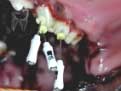
channel treatment (illustration 4), in the veterinary dentistry, it is
accomplished in a single session, where the tooth has his/her disinfected
interior (he/she leaves the necrotic and polluted material), and soon afterwards
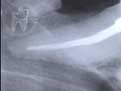
it is filled out with material obturator (illustration 5) and restored with
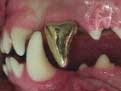
resin, amalgam or metallic prosthesis (illustration 6). This is only possible
for the fact of the procedure to be accomplished under general anesthesia,
therefore, it is not convenient to submit our patient to several sessions, as it
is done in the human dentistry.
|
 |
|
 |
|
Illustration 1 - Fourth left superior Premolar, with fracture in
chip and exhibition of the pulp lives |
|
Illustration 2 - Canine tooth right superior, with fracture of the
crown and exhibition of the channel and pulpal death. In this hole, the
bacteria invade the tooth and they arrive to the bone and they can
disperse for the whole organism |
|
 |
|
 |
|
Illustration 3 - "Fistula of the Butcher"
A) Fistula due to the infection of the bone around of the roots
B) Fourth fractured premolar, with contamination of the channel
|
|
Illustration 4 - channel Treatment in fourth superior premolar
|
|
 |
|
 |
|
Illustration 5 - X-ray of the treated tooth, with completion of the
channel with material obturator |
|
Illustration 6 - metallic Restoration of a fractured tooth and
treated endodonticamente |
Texto cedido por:
Dr. Marco Antônio León Román –
Lab. de Odontologia Comparada – FMVZ/USP e Odontovet